
REVIEW PAPER RULES
Your paper should consist of the following general sections:
| # HEADINGS | |
| 1 | Introduction |
| 2 | Body |
| * | (not a heading title within the paper) |
| 3 | Conclusions |
| Acknowledgment (optional) | |
| 4 | References |
Every section should implement the following guidelines:
| PAPER SECTION | WHAT SHOULD EVERY SECTION CONTAIN |
| 1. Introduction (Font Arial, Size 11) |
|
| 2. Body (Font Arial, Size 11) |
|
| 3. Conclusion (Font Arial, Size 11) |
|
| Acknowledgment – optional (Font Arial, Size 11) |
|
| 4. References (Font Arial, Size 11) |
|
The author should apply the following Paper Element Rules when writing their paper:
TABLES
Tables should be consecutively cited in the text. Each table should be announced in the last sentence before its introduction, as can be seen in the examples below:
Example 1 – In researching display campaigns on Facebook, we can see the results in each of the stages of the purchased funnel used (Table 1).
Example 2 – The following Table 1 clearly explains the results in each of the stages of the purchased funnel.
Table 1. Display campaigns on Facebook
Phase | Cost / Conversion | Click Through Rate (CTR) | Conversion Rate | Impressions / Conversions |
Awareness | 10.5 € | 0.5 % | 1.6 % | 12.091 |
Evaluation | 8.6 € | 0.7 % | 2.8 % | 5.454 |
Decision | 5.7 € | 1.2 % | 7.0 % | 1.204 |
Source: author’s calculations / or reference to obtained information (table)
- If applicable, include all the units of measurement.
- Each table needs a short descriptive title above it (Font Arial, Size 9, Bold), numbered consecutively with Arabic numerals, clearly defining the data
- If necessary, suitably identified footnotes (Font Arial, Size 8) should be typed directly below the table and should be referred to by superscript lowercase letters identifying connection with the main table.
FIGURES
Figures (photographs, illustrations, diagrams, schemes) should be consecutively cited in the text. Each figure should be announced in the last sentence before its introduction, as can be seen in the examples below:
Example 1 – Following the results of the biannual car sales in the USA, we can see a certain market trend starting to emerge (Figure 1).
Example 2 – In Figure 1 you can see the trend of biannual car sales in the USA.
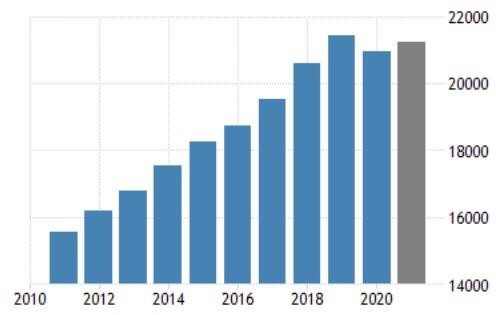
Figure 1. Biannual car sales in the USA
- If applicable, include all the units of measurement.
- Each Figure needs a short descriptive title below it (Font Arial, Size 9, Bold), numbered consecutively with Arabic numerals, clearly defining the data
- Each figure, or group of Figures, should be planned to fit into the area of either one or two columns of text. The maximum finished size of a Figure is 8.0 cm in width or less.
- Figures should also be in an electronic form, as TIFF or JPG files, with a minimum of 300 dpi, or a higher resolution.
EQUATIONS
- Equations used should be consecutively written and marked in the text (Font Arial, Size 8, Bold), numbered consecutively with Arabic numerals, clearly defining the data presented for each part of the equation.
- Make sure you place the equations in a table format, with one section for the equation, and one for the numeration.
Example – Based on the aggregated results of all tests, an estimate of the trend is described by the following equation (Eq. 1):
𝐴𝑠 = 1,76∗ − 0, 03∗∗𝑡 (1)
Where:
𝐴𝑠– share on the total consumer basket
* – 𝛼 = 0,01
** – 𝛼 = 0,05
𝑡 – time
UNITS
- The SI (Systéme Internationale d’Unites) for quantities and units should be used throughout the whole text. If nomenclature is specialized, the section should be included at the end of the paper, giving definitions and dimensions for all terms.
- Everything in Latin should be italicized (ex. per capita).
ABBREVIATIONS
- Abbreviations can be used throughout the text, pending they have already been explained at least three times in their full name before the abbreviation is used.
- Standard abbreviations include min., cm., mL, etc.
- In general, abbreviations should not be written in the plural.
Example – Organization for Economic Co-operation and Development (OECD).
CITATIONS
- It is essential to credit published papers for the work done in your
- In-text citations should refer to the reference list.
- When citing, only the surname of up to two authors may be given, whereas in the case of more than two authors, quote only the surname of the first author and add et (in italics), for example:
Example 1 (up to two authors) – Moore and Moschis, [1]
Example 2 (more than two authors) – Levin et al., [1]
REFERENCES
General Rules
- Literature references should be written in Font Arial, Size 9, numbered consecutively with Arabic numerals in square brackets, and listed in order of citation in the text.
- If the titles are in languages other than English, then the language in which it is written should be provided (ex. Law on Electronic Invoicing (in Serbian)).
- For online citations, a minimum that should be provided is the author/s (or web page owner/s) surname/s, date of publishing, title, the full URL, and the full date (day, month, year) when the citation was accessed.
- Each reference is split into 3 parts: Authors and Year; Title; Publishing All 3 parts are separated by full stops.
- Authors’ or Editors’ names should be written in the following manner: Last name – full, Middle Name (if applicable) – only the first letter, First name – only the first letter.
- In References you should write the full names of all authors and/or Editors, without using et
- Year of publishing should be written in brackets, after the authors or
- Titles should always be written in italic.
- A general type of reference example can look like this:
[1] Dastidar S. G., Datta B. (2009). Demographic differences in consumer exploratory tendencies: An empirical examination (in Indian). IIMB Management Review, Vol. 21, No. 4, pp. 297–312.
Types of Reference Structures
Books / Manuals (1st edition)
[1] Murray, N. M. (2011). Economic controversies. Ludwig von Mises Institute.
Books / Manuals (2nd, 3rd, etc. editions)
[1] DePamphilis, D. (2021). Mergers, acquisitions, and other restructuring activities (11th ed.). Academic Press.
Book chapters
[1] Haselton, M. G., Nettle, D., & Andrews, P. W. (2005). The evolution of cognitive bias. In D. M. Buss (Ed.), The Handbook of evolutionary psychology (pp. 724-746). John Wiley & Sons.
Journals/Papers
[1] Abubakar, A. M., Ilkan, M., Al-Tal, R. M., & Eluwole, K. K. (2017). eWOM, revisit intention, destination trust, and gender. Journal of Hospitality and Tourism Management, 31, pp. 220-227.
Scientific meetings
(Congresses, Conferences, etc.)
[1] Ickler, H., Schülke, S., Wilfling, S., & Baumöl, U. (2009). New challenges in e-commerce: How social commerce influences the customer process. In Proceedings of the 5th National Conference on Computing and Information Technology (NCCIT) (pp. 51-57).
White papers / Reports
[1] International Monetary Fund. (2018). World economic outlook. IMF.
Laws / Regulations
[1] Serbian Ministry of Finances. (2015). Law on electronic invoicing (in Serbian). Official Gazette of RS, No. 44/2021.
Online Citations
[1] World Economic Forum, The Global Competitiveness Report 2023, 2023. Accessed: precise date.
<URL: https://www.weforum.org/reports/the-global-competitiveness-report-2023.